Friday, 29 December 2017

New Year's resolution

New Year's resolutions are not something I usually bother with, but this year I'll be making one that I have every intention of keeping.  I'm going to swear off making on-line comments on newspaper articles.

Getting involved with the troglodytes that hang around the comments boards has always been a fool's game.  During the Greek debt crisis a few years ago, it was received wisdom that the chief problem was that those feckless Hellenes just didn't pay their taxes.  Fix that, and all would be well.  A quick check of the OECD website produced a table showing that in truth, the taxation-to-GDP ratio in Greece was much higher than in most other countries.  Pointing this out earned me a quick invitation to, well, go away, along with the OECD and the horse we rode in on.

There are plenty of more recent examples I could quote, but the key thing I'm noticing now is that commenters have become even more irascible and contemptuous of facts*.  I suppose if Donald Trump keeps getting away with it, a lot of other people feel they can too. So in 2018 I'll be confining myself to expressing my opinions here, and staying well away from the Great Wen that the comments boards have become.

* UPDATE, December 31: When I wrote the original post I was looking for a particular quote to include.  Couldn't find it because I thought it was HL Mencken but in fact it's Hannah Arendt: 

“The ideal subject of totalitarian rule is not the convinced Nazi or the convinced Communist, but people for whom the distinction between fact and fiction (i.e., the reality of experience) and the distinction between true and false (i.e., the standards of thought) no longer exist.”


Thanks for stopping by in 2017, and happy new year!    

New Year's lack of resolution


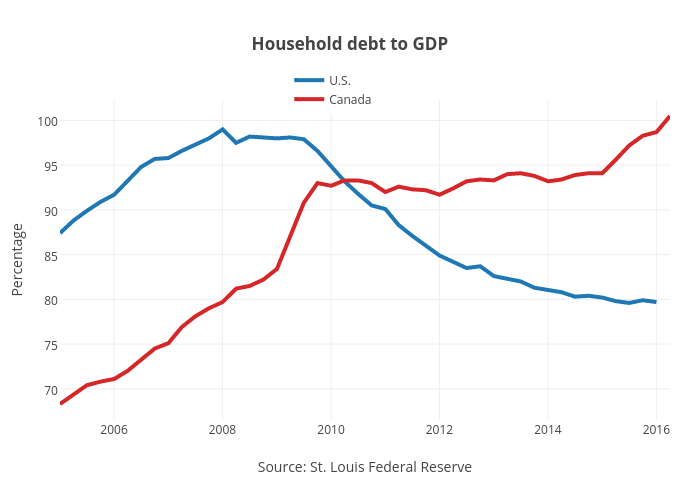
You've got to love this new survey from CIBC on Canadians' financial priorities for 2018.  Fully 25 percent of respondents said that debt reduction was their main goal in 2018, compared to 15 percent opting for "just getting by" and smaller percentages for things like boosting investments or saving for a vacation.

Here's the thing, though.  Debt reduction has been identified as the main priority in the survey for each of the past eight years.  And what has happened to household debt during that period?  This has:
Image result for canada household debt to income chart

Wednesday, 27 December 2017

An undertaking of great advantage

I've largely ignored Bitcoin in this blog, for a variety of reasons.  Although the Blockchain technology that lies behind cryptocurrencies seems likely to be of lasting importance, it's far from certain that the cryptocurrencies themselves, at least as we presently know them, will last.  A number of central banks, including the Bank of Canada, are musing about launching cryptos of their own.  It's likely that serious people, as opposed to money launderers or speculators, would prefer their Blockchain-driven currency to be sponsored by a central bank rather than by the Winklevoss brothers*.

Another reason I've written very little about Bitcoin is that although it shows all of the classic signs of a bubble, it's always very difficult to predict when the air will come rushing out.  Still, it's hard not to laugh when you see the struggling beverage maker Long Island Iced Tea change its name to Long Blockchain, as happened last week, and immediately see a surge in its stock price.  Maybe I should change the name of the blog: "Let me say this about Blockchain" has a nice ring to it.

I think I am on solid ground if I say that most of the latecomers to the Bitcoin frenzy, the kind of folks remortgaging their homes to get a piece of the action, haven't the faintest idea what it's about or how it works.  Nothing new there, either:  one of the most famous scams at the height of the South Sea Bubble of 1720 involved "a company for carrying on an undertaking of great advantage, but nobody to know what it is".  Bitcoin has certainly brought great advantage to early investors; later ones, I'm guessing, not so much.  

* I may be the only person in the world who came out of "The Social Network" feeling that the "Winklevi" looked a whole lot more honourable than a lot of the other players, so I'm certainly not suggesting there's anything wrong with their profiting from Bitcoin. 

Sunday, 24 December 2017

A waste of time and energy

Just before it closed up for the holidays this past Friday, Finance Canada released a set of long term fiscal projections.   Thanks to the stronger GDP growth seen in the past year or so, the baseline forecast now sees the Federal deficit falling to zero by....(drum roll please) 2045, almost a decade earlier than was projected last year.

It's hard to know whether to laugh or cry.  There will be at least six more elections before 2045, so any assumption of policy continuity is a complete non-starter.  And of course, we could be looking at the collapse of NAFTA, the demise of fossil fuels, wars and rumours of wars and any number of events that simply cannot be foreseen.

It's a good idea to have a baseline forecast in place to benchmark yourself against but really, what possible value is there in looking this far into the future?  And yet the media have been lapping this up, even complaining that it's naughty of Finance Canada to release it so close to Christmas each year.  My suggestion for next year: don't bother updating the report at all -- it's junk economics.

Thursday, 21 December 2017

Over to you, Governor Poloz

Statistics Canada reported this morning that consumer prices rose 2.1 percent in the year to November, up sharply from a 1.4 percent year-on-year increase in October. This is the first time headline CPI has moved above the Bank of Canada's notional inflation target since January and only the second time it has done so since 2014.  While StatsCan identifies fuel prices, up a hefty 19.6 percent, as the main culprit for the rise in inflation, there are plenty of signs that price pressures are becoming more broad based, with seven of the eight sub-components of CPI rising*. 

Until this latest report, there had been some comfort for the Bank in the fact that its three slightly arcane core inflation measures were significantly below the 2 percent target.  However, two of those indices have also now moved up to just below the target level.

Governor Poloz has stressed that the Bank's future rate decisions will be data-driven, and that the Bank is still inclined to proceed cautiously.  Still, the fact that CPI is moving higher even though the exchange rate has been relatively stable makes it very likely that another rate hike will be forthcoming in January.

* The exception: clothing and footwear. 

Tuesday, 19 December 2017

Non-residents a non-factor?

A new report from the Canadian Government's housing agency, CMHC, seems to suggest that only about 5 percent of the country's housing stock is owned by non-residents.  Ergo, in the instant opinion of the news media, foreign buyers are not the primary cause of the unaffordability of housing in major cities, particularly Toronto and Vancouver.

No doubt there are other factors at work, especially the availability of cheap money and the apparent willingness of many Canadians to take on enough debt to choke a horse. All the same, there do seem to be grounds for assuming that the CMHC's data are understating the influence of foreign buyers and, credit where it's due, many of the problems with the data have been picked up in the comments on the linked article.

  • The data are based on self-reporting, which is intrinsically problematic.  For example, how are dual passport holders classified? 
  • Given that the ownership of the overall housing stock changes hands only gradually, it would be more informative to know what proportion of sales were attributable to foreign buyers, rather than what proportion of the country's total housing stock they now own.


  • CMHC's data appear to count a home as foreign owned only if the owner is not resident in it, yet it is well known that many Asian buyers have purchased properties for their offspring attending Canadian universities, often registering the properties in the child's name. Such properties should surely be counted among those foreign owned, but in the CMHC's methodology, they aren't.  

Regardless of these problems with the numbers, it seems reasonable to conclude that the lion's share of the blame for high house prices should not be laid at the door of foreign buyers.  That blame belongs with the central bank, as well as with lenders who have continued to dole out money even as warnings of building stress levels have become ever louder.  The evident intention of the Bank of Canada to keep raising interest rates, coupled with new mortgage stress tests in the New Year, could make 2018 a much trickier year for the Canadian housing sector.

Thursday, 14 December 2017

All housing, all the time

It's forecasting season in Canada, and the housing industry is front and centre.  Following on from yesterday's rosy forecast for house prices from Royal LePage, today brings several more tasty morsels.

  • Here is a much less bullish outlook from another huge realtor, ReMax, forecasting that Toronto-area housing prices will fall sharply in early 2018 as a result of new mortgage stress tests (see yesterday's post), before bouncing back later in the year to end up basically unchanged from current levels.
  • Here we have the Canadian Real Estate Association (CREA) predicting that those same mortgage rules will lead to a more than 5 percent fall in home sales in 2018, with prices nationwide edging lower. 
  • Here is a report, originally from Bloomberg, suggesting that borrowers facing problems as a result of the new mortgage rules are increasingly turning to unregulated mortgage lenders, paying fancy prices for the privilege and increasing systemic risk.
  • And if that's not scary enough, here is a report on new data from Statistics Canada showing that Canadian household debt has reached yet another record high, at 171.1 percent of disposable income. 

You've got to love the last sentence in that final story, a quote from a gent at the Credit Counselling Society: "Canadians need to gain control of their finances and use a budget/spending plan to effectively manage their expenses".  Good luck with that one, sunshine -- you're going to be a busy boy in 2018. At least, that's my forecast.